
Lake Titicaca Guide
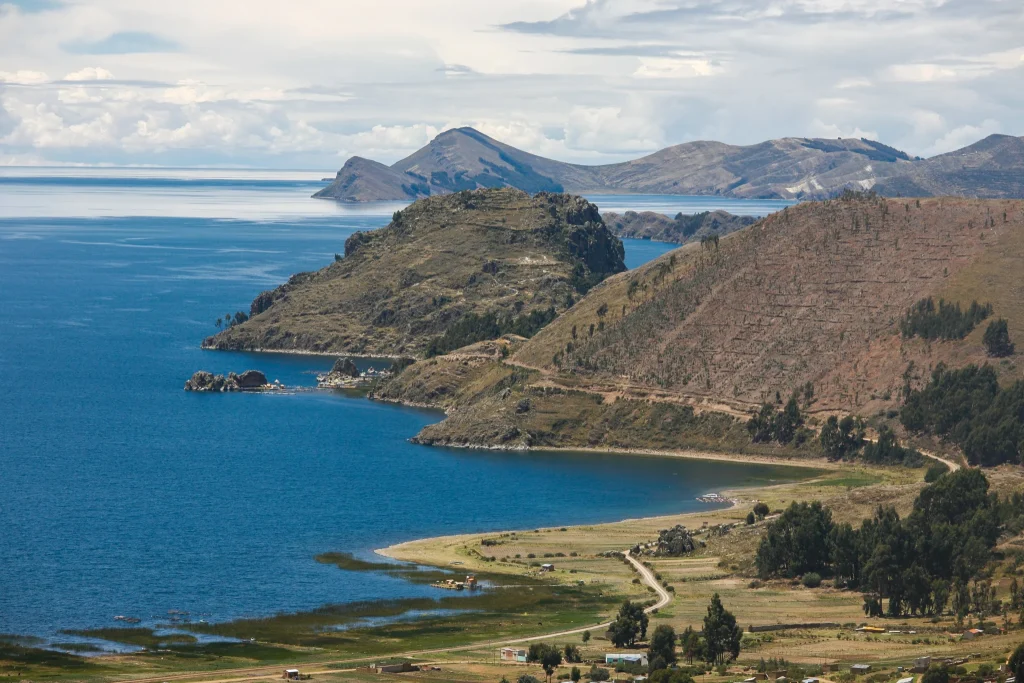
Lake Titicaca belongs in a Peru and Bolivia itinerary, not an Argentina route. Puno is the most practical base described for the Peruvian shore, while Copacabana and La Paz are important reference points when planning the Bolivian side. The main decisions are simple but consequential: choose one country or both, decide how much time to spend beyond Puno, and confirm current transport details before departure.
- Use Puno as the straightforward departure base for visiting the Peruvian side of Lake Titicaca.
- Allow about 20 minutes to walk 1.2 kilometres from Puno’s Plaza Mayor to the lake port.
- Plan Peru and Bolivia as separate travel segments, with current border requirements and transport schedules checked before departure.
- Consider Karina and Churo for a less-central lakeshore visit, but allow time for local transport and a final walk.
- Treat May through December as birdwatching guidance, not a universal best season for every Lake Titicaca activity.
This guide therefore focuses on the lake’s actual visitor geography in Peru and Bolivia. Travelers building a wider Andean journey should keep Argentina as a separate destination rather than treating it as a gateway to Lake Titicaca.
Choose the Peruvian side, the Bolivian side or both
Choose the Peruvian side if easy access to Puno’s urban services and lake port is your priority. Choose a two-country itinerary if Copacabana or La Paz also fits your route and you have enough flexibility for a border crossing. Our Peru destination guide and Bolivia destination guide can help place each side within a broader country itinerary.
| Trip style | Useful base or reference point | Main planning consideration |
|---|---|---|
| Peruvian side | Puno | Convenient access to the lake port and urban services. |
| Bolivian side | Copacabana or La Paz route | Confirm current ground transport, crossing arrangements and local departure details. |
| Both countries | Puno plus a separately planned Bolivia segment | Allow flexibility for border formalities and changing transport schedules. |
A one-country trip reduces logistical pressure. A two-country route offers a broader view of the lake region but introduces separate entry requirements, border operating hours and transport arrangements. Build that extra administration into the itinerary rather than treating the crossing as a minor transfer.
Why Puno works well as a Peruvian base
Puno offers the clearest combination of city accommodation, onward transport and access to the lake port. Its central location also gives travelers a choice between organized departures and independent lakeshore excursions. Staying near the center can make the port reachable on foot, although luggage, mobility needs and departure times can make a taxi more practical.
When a Bolivia segment makes sense
A Bolivia segment makes sense when Copacabana or La Paz already forms part of the route. The Tiquina Strait is part of the travel relationship connecting the Bolivian side with journeys toward Puno, but it does not remove the need to check current border rules, local transfers and departure times.
Reach the Lake Titicaca port from central Puno
The lake port is close enough to central Puno for many travelers to reach it without a complicated transfer. The official planning estimate from Plaza Mayor is a 1.2-kilometre walk taking about 20 minutes. From the Costanera-Titicaca corner, the remaining walk is about 400 metres and takes roughly 10 minutes.
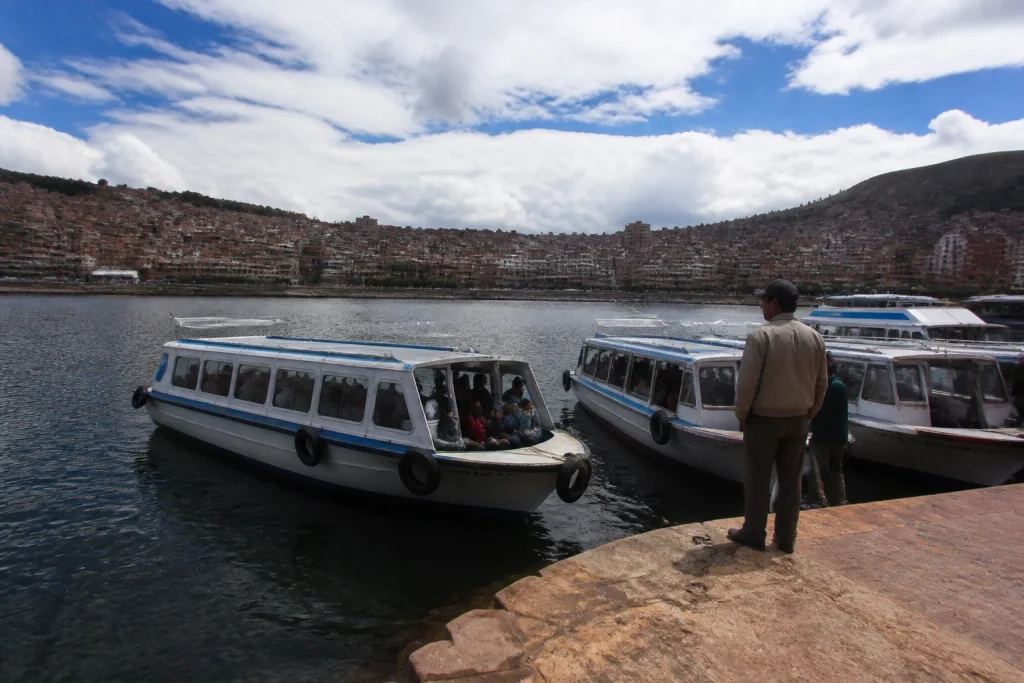
- From Plaza Mayor, allow about 20 minutes for the 1.2-kilometre walk to the port.
- From Puno’s interprovincial bus terminal, a taxi estimate to the Costanera-Titicaca corner is about eight minutes over 1.2 kilometres.
- From that corner, continue approximately 400 metres on foot to the port, allowing about 10 minutes.
Treat these figures as orientation, not a guaranteed transfer schedule. Traffic, walking speed, baggage and the exact embarkation point can change the time needed. Leave a buffer before a booked departure and use the meeting instructions supplied by the boat or tour provider.
For contemporary local services, Peru’s Ministry of Foreign Trade and Tourism published a Puno-Lake Titicaca traveler guide in March 2026, accompanied by listings for lodging, food and travel agencies. Use the latest edition when comparing local providers, then confirm the meeting point and departure time for the service selected.
Balance Puno’s convenience with a lakeshore detour
Puno is the efficient choice for reaching the port, but it is not the only way to spend time beside the lake. Karina and Churo provide an example of a less-central lakeshore outing that requires additional local transport and walking. This tradeoff matters when deciding between a compact schedule and a slower visit beyond the main departure point.
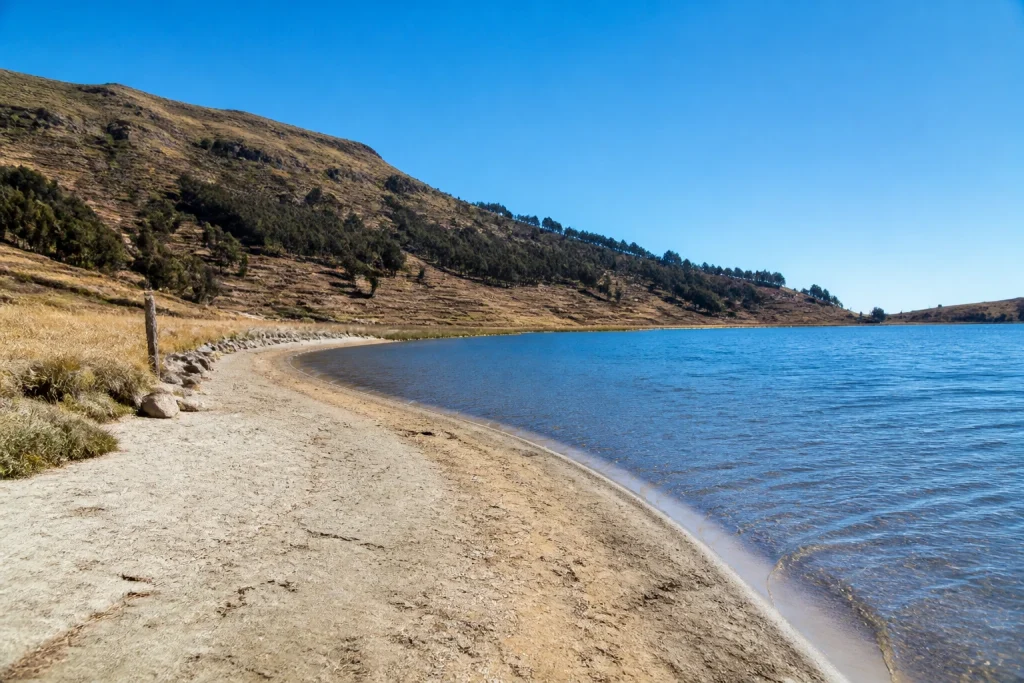
The official route estimate places the Karina and Churo beaches about 54 kilometres from Puno. The combi journey is listed at roughly one hour and 20 minutes, followed by a 300-metre walk. Access to the beaches is listed as free, although travelers still need to budget for transport and any independently arranged services.
- Choose central Puno when port access and simple logistics matter most.
- Choose a lakeshore detour when you can devote extra time to local transport and walking.
- Carry only what you can manage over the final approach if your route includes an unpaved or pedestrian section.
- Confirm the return journey before leaving Puno, especially when relying on local transport.
Do not crowd a lakeshore detour into the same narrow window as a fixed boat departure. The journey to Karina and Churo already requires more than an hour in transit before the final walk, so it works better as a deliberate excursion than as a quick addition near the port.
Plan a Peru-Bolivia crossing as a separate journey
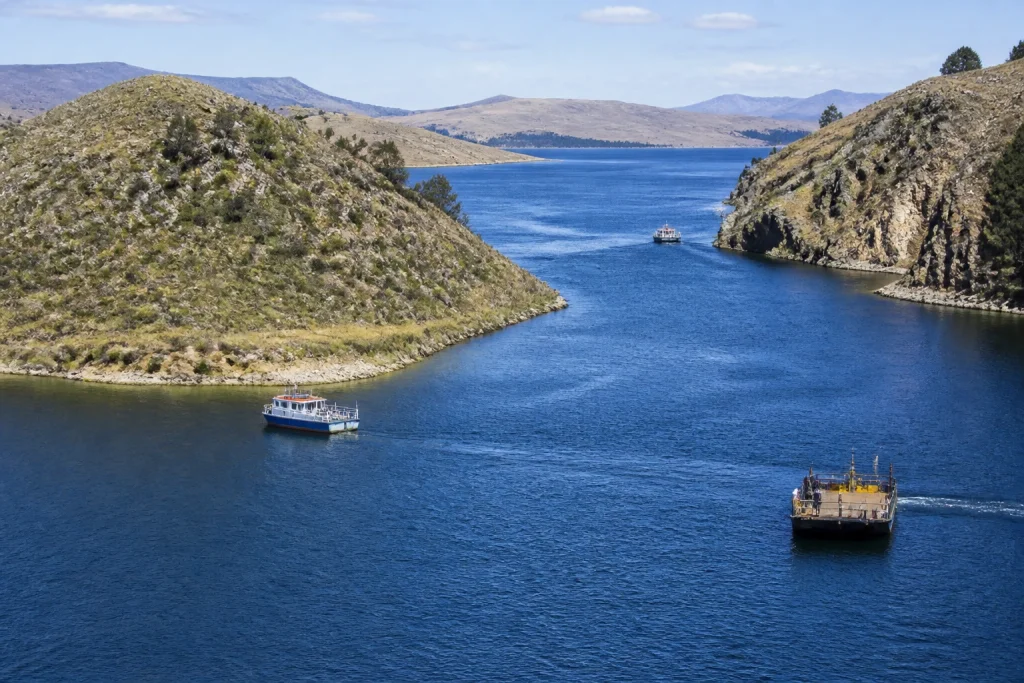
Cross-border Lake Titicaca travel requires a separate plan for each country. The regional route connects travel between Puno and the Copacabana or La Paz side through the Tiquina Strait, but border hours, entry conditions, bus schedules and boat arrangements can change. Check each operational detail shortly before travel.
- Check the entry requirements that apply to your nationality for both Peru and Bolivia.
- Verify the current border operating hours for your intended travel date.
- Confirm where each bus or transfer begins and whether a change of vehicle is required.
- Allow extra time rather than placing a fixed tour or flight immediately after the crossing.
- Recheck the selected operator’s status shortly before departure.
Live conditions deserve attention on any cross-border itinerary. Review current official safety, weather, transport and navigation notices before leaving, and confirm that the chosen provider is operating. This is more useful than relying on an old timetable or assuming that an earlier traveler’s route still runs unchanged.
Travelers continuing deeper into Bolivia can place the lake before or after a wider Altiplano journey. The Uyuni Salt Flats three-day Bolivian Altiplano guide is a useful planning companion, but leave enough flexibility between the lake crossing and any fixed onward departure.
Match the season to the activity you care about
For protected-area birdwatching, official guidance identifies May through December as the best period because Lake Titicaca’s water level is lower. This is specific advice for observing birds. It should not be stretched into a claim that the same months are automatically best for boating, border travel or every other lake activity.
For a general visit, coordinate the date with the service you intend to use. Check the provider’s current operating pattern, review the forecast and keep some flexibility if navigation or ground transport is affected. Cross-border travelers should also review live conditions on both sides of the lake.
- Birdwatching priority: consider May through December.
- Boat trip priority: confirm the provider’s operating status and departure instructions.
- Cross-border priority: check entry rules, border hours and onward transport.
- Lakeshore priority: verify local transport for the outward and return journeys.
Activity-specific planning is more reliable than choosing dates from a broad seasonal slogan. A useful travel window for birdwatching does not guarantee that every transport connection or tour will suit the same itinerary.
Build a budget without relying on outdated price lists
Current fares and visitor prices vary by route, date and provider, so build the budget by category rather than around an old package total. Compare what each quote includes, especially transfers, boat travel, local transport and any services arranged away from central Puno.
- Accommodation in Puno or on the chosen side of the lake
- Transport to Puno and onward travel toward Bolivia, if applicable
- Transfer or walk to the Puno lake port
- Boat, tour or independently arranged lake service
- Local transport for less-central shore visits
- Meals, border-related expenses and schedule-change contingency funds
Karina and Churo are listed with free access, but that does not make the outing cost-free. The route still involves local transport, and any food, guide or additional service remains separate. Ask what is included before comparing a shore excursion with a departure from Puno’s main port.
Avoid treating infrastructure investment figures as visitor prices. They describe public works rather than what a traveler pays. For a useful comparison, collect current quotes for your dates and judge them on inclusions, cancellation terms, meeting points and total travel time.
Confirm accessibility before reserving a lake departure
Do not assume that the full route is step-free. A 2019 study identified architectural barriers at Puno’s lake port and found that it did not comprehensively serve travelers with motor disabilities at that time. Conditions can change, particularly as embarkation improvements move forward, so the old assessment is not a substitute for current trip-specific information.
Before booking, ask the boat operator for clear information about the route from street to vessel. The most useful details are step-free access, boarding assistance, transfer vehicles, vessel entry and conditions at every intended stop. Travelers should assess the complete journey rather than the port alone.
- Ask whether the route from drop-off point to vessel is step-free.
- Confirm what boarding assistance and transfer equipment are available.
- Check the surface, gradients and boarding conditions at every planned stop.
- Make sure the return journey provides the same level of assistance.
Use this planning sequence before you travel
- Choose Peru, Bolivia or a two-country route before booking transport.
- Select Puno as your base if convenient access to the Peruvian port is the priority.
- Decide whether a less-central shore visit justifies the additional transport time.
- Compare current services by inclusions rather than relying on an old headline price.
- Confirm the meeting point, departure time and any accessibility arrangements.
- Recheck border, transport, weather, safety and navigation notices shortly before travel.
Complete the decisions in that order. Booking individual components before deciding which country or shore you want to prioritize can create unnecessary backtracking. The 2026 Puno-Lake Titicaca traveler guide is a sensible starting point for finding contemporary local service categories on the Peruvian side.
Three practical ways to shape a Lake Titicaca itinerary
A Puno-centered visit
Base yourself in Puno, use the port for your selected lake service and keep the rest of the schedule simple. This format suits travelers prioritizing easy logistics or working with limited time. Stay aware that the provider’s meeting point may differ from the general port entrance, so follow the booking instructions rather than relying only on the central walking estimate.
A Puno stay with a less-central shore excursion
Combine Puno’s practical transport connections with a separate outing toward Karina and Churo. This format suits travelers who can devote additional time to local transport and the final walk. Plan the return before setting out, and avoid placing the excursion immediately before a fixed departure from the port or bus terminal.
A two-country lake journey
Link Puno with the Copacabana or La Paz side as a dedicated cross-border segment. This format suits travelers with enough schedule flexibility to handle border procedures and transport changes. Confirm each leg separately and avoid depending on an unverified same-day connection to a nonrefundable onward booking.
| Plan shape | Best suited to | Critical check |
|---|---|---|
| Puno-centered | Travelers prioritizing port convenience | Exact meeting point and departure time |
| Puno plus lakeshore | Travelers with time for local transport and walking | Return transport from the shore |
| Peru and Bolivia | Flexible cross-border itineraries | Entry rules, border hours and each transport leg |
Make the final choice based on logistics, not a checklist
Lake Titicaca works best when the itinerary has one clear priority. Choose Puno for straightforward access to the Peruvian port, add a less-central shore visit when you have time for local transport, or build a separate Bolivia segment when the border crossing genuinely advances the wider route.
The main limitation is that prices, schedules, border conditions and provider operations can change. Set the route first, compare current services second, and complete one final status check shortly before travel. That approach keeps the plan useful without packing the itinerary so tightly that one change disrupts everything after it.
Frequently asked questions
Is Lake Titicaca in Argentina?
No. Lake Titicaca belongs in a Peru and Bolivia itinerary, with Puno serving as a practical gateway on the Peruvian side and Copacabana or La Paz relevant to planning the Bolivian side.
What is the best base for visiting Lake Titicaca in Peru?
Puno is the most practical base described for the Peruvian side. It combines an urban base with convenient access to the lake port.
Can you walk from central Puno to the Lake Titicaca port?
Yes. The planning estimate from Puno’s Plaza Mayor is 1.2 kilometres and about 20 minutes on foot. From the Costanera-Titicaca corner, the walk is approximately 400 metres and 10 minutes.
What is the best time to visit Lake Titicaca?
For protected-area birdwatching, official guidance favors May through December because the lake’s water level is lower. For other activities, check current provider operations and conditions rather than treating that period as a universal best season.
Can you travel between Peru and Bolivia through the Lake Titicaca region?
Yes, but the Peru-Bolivia segment requires separate planning. Confirm current entry rules, border hours and ground or boat transport details before departure.
Is the Puno lake port wheelchair accessible?
Do not assume the complete route is step-free. A 2019 study documented architectural barriers, while later improvement planning means current conditions should be confirmed directly with the operator, including boarding assistance and conditions at each stop.
How much does a Lake Titicaca visit cost?
Prices vary by date, route, provider and included services. Compare current quotes for transport, boat travel, transfers and accommodation, and do not mistake public infrastructure spending for a visitor price.
Are Karina and Churo easy to visit from Puno?
They require more time than the central port. The listed route is about 54 kilometres and one hour and 20 minutes by combi, followed by a 300-metre walk; access to the beaches is listed as free.
Lake Titicaca spans the visitor geography of Peru and Bolivia by Alex Proimos from Sydney, Australia, CC BY 2.0.
.jpg)
More bookable experiences
Three tours to compare
Review current provider details before booking. Discover Andes may earn a commission at no extra cost to you.
Continue exploring
More practical guides selected from the Discover Andes library.
The Andes New Year’s Eve Guide
Plan New Year's Eve in the Argentine Andes with practical advice on Mendoza, the Uco Valley, Bariloche, summer…
Best Bars in The Andes
Explore the strongest drinks experiences in Argentina’s Andes, including Mendoza’s urban bar districts, vineyard tasting venues, an urban…
The Andes Luxury Travel Guide
Plan a refined journey through Argentina’s Andes, with Mendoza wine country, Salta’s high desert, private mountain touring, seasonal…
The Andes by Night Guide
Plan an evening or overnight journey into Argentina’s high Andes, with practical guidance on Salta and Jujuy gateways,…