
The Andes Shopping Guide
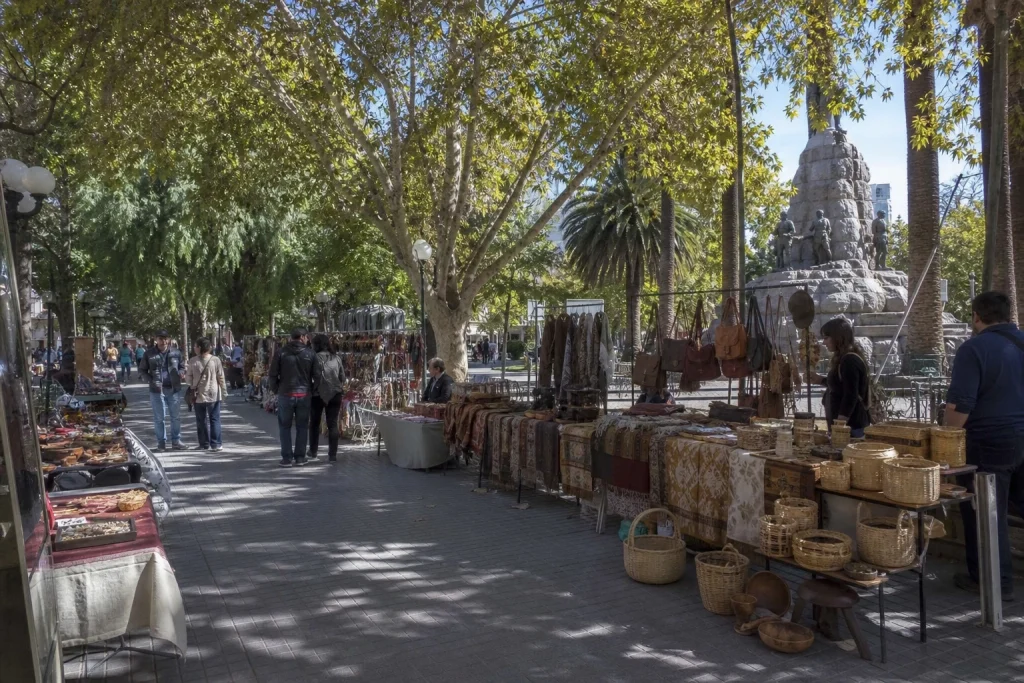
Shopping in the Argentine Andes is best approached through Mendoza. The province combines a major wine economy with government-linked artisan venues selling regional textiles, leatherwork, basketry, and other locally made goods. This guide focuses on Mendoza City and treats mountain excursions as a separate part of the trip. That distinction matters because market schedules, altitude, winter weather, packing needs, and tax-refund paperwork all shape what is practical to buy.
- Use Mendoza City as the main shopping base rather than treating the entire Argentine Andes as one retail district.
- Start with the Mendoza Artisan Market and Plaza de las Artes for government-linked, locally made crafts.
- Look for loom-woven textiles, leatherwork, and Huarpe basketry, but ask about the maker and materials before buying.
- Check artisan-market schedules shortly before visiting because days, hours, and participating vendors can change.
- Eligible foreign tourists can claim VAT refunds on qualifying purchases from participating businesses, but the refund is reduced by a service commission.
- Keep mountain outings separate from city shopping, especially during the June-to-September snow season.
Why Mendoza leads an Argentine Andes shopping trip
Mendoza offers the clearest combination of Andean scenery, established visitor infrastructure, wine culture, and documented artisan-shopping venues. It is a stronger starting point than a vague route through multiple mountain towns, where retail choices and operating schedules can differ sharply. Base the shopping portion of the trip in the city, then add vineyards or mountain landscapes according to your interests and available time.
This city-first strategy also gives shoppers more control. Formal artisan venues provide a lower-effort setting for comparing textiles, basketry, and leather goods. Mountain areas introduce cold, snow, altitude, and more complicated transport decisions, particularly in winter. A craft purchase does not become more authentic simply because it was found at a higher elevation.
For broader trip planning, the Chile and Argentina destination guide helps place Mendoza within the southern Andes. Keep the shopping plan geographically focused even if the larger itinerary crosses the region. A short list of well-supported venues is more useful than collecting unverified souvenir stops across distant towns.
The best-supported artisan shopping stops in Mendoza
The Mendoza Artisan Market, also known as Mercado Artesanal Mendocino, is the strongest starting point for regional craft shopping. It brings locally made work into a dedicated setting and includes loom weaving, leatherwork, and other crafts associated with Mendoza. Visit with enough time to compare workmanship and speak with vendors rather than making a quick purchase on the way to another attraction.
Plaza de las Artes is another useful option. Located in Plaza Independencia, it is described as an artisan venue with about 150 stands. The size can make it better suited to browsing across multiple makers, although the exact mix of vendors can vary. Its central setting also makes it easier to include in a day focused on Mendoza City instead of a mountain excursion.
Do not assume either venue follows universal daily hours. Mendoza’s artisan-fair listings include operations limited to particular days and times, while participating sellers can rotate. Confirm the current schedule shortly before visiting. This small check prevents a closed market from leaving an awkward hole in a city itinerary.
| Shopping option | Best for | Main advantage | Main tradeoff |
|---|---|---|---|
| Mendoza Artisan Market | Regional crafts in a dedicated venue | Locally made weaving, leatherwork, and other Mendoza crafts | Schedule and available stock can change |
| Plaza de las Artes | Browsing among many artisan stands | Central Plaza Independencia location and about 150 stands | Vendor mix and operating times can vary |
| Wine purchases | Travelers interested in Mendoza’s wine culture | A product closely tied to the province’s visitor economy | Heavier to transport and subject to travel and import rules |
Regional crafts worth looking for
Loom-woven textiles are among the most distinctive portable purchases documented at Mendoza’s artisan venues. Examine the edges, weave consistency, texture, and finishing before choosing. Ask what fiber was used, who made the piece, and where it was produced. These questions help separate a regional craft purchase from an item selected only for its mountain-themed appearance.

Raw-leather work is another regional category highlighted by Mendoza’s artisan-market program. Leather can be practical, but buyers should inspect seams, fastenings, edges, and surface finishing. Consider how the item will travel in luggage and whether it could mark nearby clothing. A modest piece that packs flat often makes more sense than a bulky object requiring special handling.
Huarpe basketry carries a stronger cultural connection than a generic souvenir, so maker information matters. Ask about the materials and production method without expecting every seller to provide a long explanation. If a vendor identifies the maker or community, retain that information with the receipt. It gives the object useful context once it leaves Mendoza.
- Loom-woven textiles that fold easily and fit inside luggage
- Small leather goods with tidy stitching and finished edges
- Basketry accompanied by clear information about its maker or origin
- Useful household objects rather than purely decorative mountain motifs
- Lightweight gifts that can be protected without oversized packaging
Government-linked fairs are particularly useful for travelers who value direct contact with producers. Mendoza describes its fair network as supporting producer-to-consumer sales without intermediary costs. That does not guarantee that every object will be inexpensive. It does provide a better framework for asking who made an item and understanding what the purchase supports.
Treat wine shopping as a separate purchase decision
Wine is central to Mendoza’s identity as a visitor destination, but buying bottles requires a different plan from buying textiles or basketry. Bottles are heavy, fragile, and less forgiving of rushed packing. Before purchasing, consider baggage limits, protective packaging, transfers, and the import rules applied at the final destination.
Avoid treating every wine purchase as an automatic tax-free bargain. Eligibility depends on the goods, the business, the documents issued, and completion of the refund process. A bottle that suits the trip and can be transported safely is a better choice than one purchased only because a refund seems possible.
Keep fragile bottles and soft crafts apart when packing. Leather can press against labels, woven fabric can absorb moisture, and basketry can be crushed by dense objects. If the shop offers protective packing, inspect it before leaving. Travelers moving between several hotels should favor purchases that can survive repeated handling.
There is no dependable fixed price list for Mendoza retail shopping. Prices can change, product quality varies, and handmade pieces are rarely identical. Set a personal budget by category and compare similar objects at more than one stand. This produces a more useful sense of value than converting an old online price into current currency.
How to choose a locally made item with confidence
Begin with three simple questions: Who made it? Where was it made? What material was used? Clear answers do not need to sound rehearsed. A seller who can explain the basic origin and construction gives the buyer more context than a display relying on broad labels such as “Andean” or “traditional.”
Next, inspect the object as something you will actually own. Check woven pieces for loose sections, leather for unfinished edges, and basketry for crushed or unstable areas. Handmade work can include natural variations. The goal is not machine-like uniformity, but sound construction and a finish that suits the intended use.
Ask for a receipt and keep it with any maker information. This is essential if the purchase is intended for a VAT refund, and it is helpful even when no refund applies. Photographing the item beside its paperwork before packing can also simplify identification later, especially when several gifts look similar.
The most rewarding Mendoza souvenir is one whose maker, material, purpose, and transport needs are clear before it enters your suitcase.
There is no need to rush into bargaining or assume that every artisan venue follows the same sales customs. Compare first, ask direct questions, and decide what the piece is worth to you. The producer-to-consumer structure can reduce intermediary costs, but craftsmanship, materials, and time still shape value.
Claiming Argentina’s VAT refund on eligible goods
Eligible foreign tourists can claim a VAT refund on qualifying taxable goods produced in Argentina and purchased from participating businesses. The process is not automatic. The buyer needs the required purchase documentation and must complete validation when exporting the goods through an authorized departure point with customs personnel.

- Before paying, establish that the business participates in the tourist VAT-refund system and that the selected goods qualify.
- Request the qualifying B invoice or ticket and the electronic refund cheque at the time of purchase.
- Check that the documentation matches the purchase and retain it with your travel papers.
- Keep the purchased goods available because customs can require them during validation.
- Allow extra time at an authorized departure point to complete the required validation or export procedure.
- Retain the refund records until the process is complete.
Travelers routed to physical customs control must be ready to present the goods, purchase receipt, electronic refund cheque, identity or travel document, and boarding pass. Packing refundable items deep inside checked luggage before validation can create an avoidable problem. Organize the documents and goods before reaching the departure point.
Do not describe the refund as a full 21 percent saving. The service provider deducts a commission, so the amount returned is lower than the headline tax rate. This makes the refund useful, but it should not be the only reason to choose one handmade object over another.
Rules and processing arrangements can change, so review the current government procedure close to departure. Older descriptions of thresholds or airport routines can lag behind the 2026 electronic refund-cheque and validation framework. At the shop, the practical priorities are participation, eligible goods, and correct documents.
Time shopping around winter and mountain plans
The official snow-season window for the Mendoza Andes runs from June through September. Accommodation demand is high during this period, so booking ahead is advised. August sits within that winter window, bringing cold conditions and the possibility of snow at altitude. City shopping should remain flexible around mountain travel rather than being squeezed between weather-dependent transfers.
A sensible sequence is to shop after returning to the city, not immediately before a mountain departure. This prevents delicate crafts or bottles from spending an unnecessary day in a vehicle. It also gives travelers a clearer idea of remaining luggage space and avoids carrying purchases through cold, wet, or snowy conditions.
Market timing requires its own check. Artisan fairs can operate on limited days and hours, and vendor participation can vary. Confirm the schedule before assigning a specific morning or afternoon to shopping. If the market is essential to the trip, do not leave it until the final hours before a flight or long-distance transfer.
The Andes can experience substantial temperature variation at elevation. Carrying an extra layer and weather protection matters for mountain stops, but those conditions should not define the city-shopping day. Separate clothing, transport, and timing plans make both parts of the trip easier to manage.
Accessibility, altitude, and lower-effort shopping
Mendoza City’s formal artisan venues are the lower-effort choice for travelers with limited mobility, sensitivity to altitude, or little tolerance for winter logistics. Mountain environments demand more preparation. The Mendoza Andes average about 2,900 meters above sea level and can be cold and snowy during the winter season.
Venue-level details such as step-free entrances, adapted restrooms, and accessible transport should be confirmed directly before visiting. Avoid assuming that a central plaza location guarantees a completely barrier-free route. A brief check focused on the traveler’s specific needs is more useful than a general accessibility label.
Travelers combining shopping with higher elevations can use the plain-English Andes acclimatisation guide to plan a slower ascent. Shopping itself is rarely the difficult part. The challenge is adding it to a day already filled with elevation gain, cold weather, and transport demands.
Choose portable purchases if grip, balance, or fatigue is a concern. A folded textile is easier to manage than a large basket, while several wine bottles can quickly become cumbersome. Ask the seller to package the item before committing, then judge the final size and weight rather than the unpacked display piece.
A practical Mendoza shopping plan
A focused shopping plan can fit around the rest of a Mendoza itinerary without turning the trip into a retail marathon. The key is to decide which category matters most, verify the market schedule, and leave enough time for comparison. Wine, crafts, and mountain stops each create different transport and packing demands.


- Choose a primary goal, such as woven textiles, leatherwork, basketry, or wine.
- Check the current operating schedule for the Mendoza Artisan Market and Plaza de las Artes.
- Visit the city venue that best matches the goal, then compare several makers or stands.
- Ask about origin, materials, construction, packaging, and VAT-refund participation before paying.
- Keep receipts, maker details, and refund documents together in a secure travel folder.
- Pack purchases before the departure day and keep goods needed for customs validation accessible.
Travelers seeking locally made, traceable crafts will get the most from Mendoza’s government-linked artisan markets. Those seeking the widest possible brand selection should recognize the tradeoff: these venues emphasize regional producers, and the available sellers or stock can change. That variability is part of shopping among independent makers, but it rewards careful comparison.
Mendoza works best when city shopping and mountain exploration support each other without being forced into the same day. Start with a confirmed artisan-market schedule, choose purchases that fit the luggage, and complete tax paperwork at the point of sale. The main limitation is variability in hours and vendors. With those details settled, the result can be a practical collection of objects tied to the people and materials of the region.
Frequently asked questions
What is the best place to shop for local crafts in Mendoza?
The Mendoza Artisan Market and Plaza de las Artes are the best-supported starting points. The artisan market carries locally made weaving, leatherwork, and regional crafts, while Plaza de las Artes in Plaza Independencia is described as having about 150 stands. Confirm current operating times before visiting.
What souvenirs are associated with Mendoza’s artisan markets?
Loom-woven textiles, raw-leather work, and Huarpe basketry are among the documented regional craft categories. Ask about the maker, place of production, materials, and construction before buying.
Are Mendoza’s artisan markets open every day?
Artisan-market schedules vary, and some fairs operate only on particular days and during limited hours. Check the current schedule shortly before the planned visit rather than relying on an older timetable.
Can foreign tourists receive a VAT refund in Argentina?
Eligible foreign tourists can receive a VAT refund on qualifying Argentine-produced taxable goods purchased from participating businesses. Buyers need the qualifying receipt and electronic refund cheque, and they must complete the required validation at an authorized departure point. A service commission reduces the final refund.
Is wine a practical souvenir from Mendoza?
Wine is closely connected to Mendoza’s visitor economy, but bottles require more planning than textiles or small crafts. Consider baggage limits, protective packaging, onward transfers, and destination import rules before purchasing.
Should I shop in Mendoza City or in the mountains?
Mendoza City is the more practical base for dedicated shopping. Formal artisan venues provide a lower-effort option, while mountain areas add altitude, cold, snow, and transport considerations, especially during the June-to-September snow season.
More bookable experiences
Three tours to compare
Review current provider details before booking. Discover Andes may earn a commission at no extra cost to you.
Continue exploring
More practical guides selected from the Discover Andes library.
The Andes New Year’s Eve Guide
Plan New Year's Eve in the Argentine Andes with practical advice on Mendoza, the Uco Valley, Bariloche, summer…
Best Bars in The Andes
Explore the strongest drinks experiences in Argentina’s Andes, including Mendoza’s urban bar districts, vineyard tasting venues, an urban…
The Andes by Night Guide
Plan an evening or overnight journey into Argentina’s high Andes, with practical guidance on Salta and Jujuy gateways,…

The Andes First Night Guide
Use Mendoza as a practical first-night base for Argentina’s central Andes, then prepare for Aconcagua, Horcones, Puente del…